By Timmy, founder of AskTimmy, a Klaviyo Master Gold Partner · Last reviewed November 2026 · About 25 minutes to read

12 emails pet parents actually open.

The pet emails that get opened answer a question the owner is already asking about their pet. The ones that get skipped ask the owner to think about a discount.

Timmy, founder of AskTimmy

“We went through a year of pet brand emails looking for one thing: campaigns a team of one or two could send next week that weren’t another discount. These are the 12 we’d copy, and how we’d run them.”

Timmy, founder of AskTimmy

This is a working library of 12 email campaigns pet brands sent between November 2025 and November 2026, sorted into six themes by how each one is built. Each comes with the real email, why it works, how to run it with a small team, and an effort rating. Ten of the twelve can be written by one person in half a day, using photos you already have.

How to use this. Every email shown is the one the brand sent. Click any email to read all of it, or open it full size and download it for your swipe file. Tick the boxes as you go. Dogs, cats and small animals are all covered.

Start here

The 12 at a glance

Every campaign does one of three jobs: wins a first order, brings a customer back, or tells you something about their pet that makes the next email better.

CampaignMain jobEffort
Theme 1 · Teach something
1. The “is this normal?” explainerBring customers backMedium
2. Myth or factBring customers backLow
Theme 2 · Answer the doubt
3. Switch storiesWin a first orderLow
4. The honest FAQWin a first orderLow
Theme 3 · Ride the pet calendar
5. The night-before plannerBring customers backLow
6. A letter from the petBring customers backLow
Theme 4 · Celebrate the pet
7. Tell us about your petLearn about the petLow
8. The life-stage editBring customers backMedium
Theme 5 · Prove it
9. Proof at scaleWin a first orderLow
10. Ask, then share the repliesBring customers backLow
Theme 6 · Sell without shouting
11. The mystery giftWin a first orderLow
12. “What do they really need?”Win a first orderLow

Effort, as we use it: Low means one person, under half a day, with photos you already have. Medium means you need pet data in your email platform, new photos, or a vet or expert to check the copy. High would mean video or a content team; we left those out on purpose.

Where to start

How to choose your first three

Start with the problem your list has today.

If this sounds like your listStart with
Most subscribers have never bought4. The honest FAQ, 3. Switch stories, 9. Proof at scale
Plenty of customers, but most buy once7. Tell us about your pet, 2. Myth or fact, 10. Ask, then share the replies
A pet holiday or fireworks night is less than six weeks away5. The night-before planner or 6. A letter from the pet, then two from above
You discount every month and margins hurt11. The mystery gift and 12. “What do they really need?” in place of your next two codes

Judge each campaign on orders and replies over the following week. Opens alone can mislead. Then keep the two that worked and make them a monthly habit.

Theme 1 of 6

Teach something

An educational pet email gets opened because it names a worry the owner already has. The product comes in once, near the end, as one of the answers.

Pet owners look things up about their pets every week. When your emails answer those questions, they start opening yours before they search.

Campaign 1 · Bring customers back

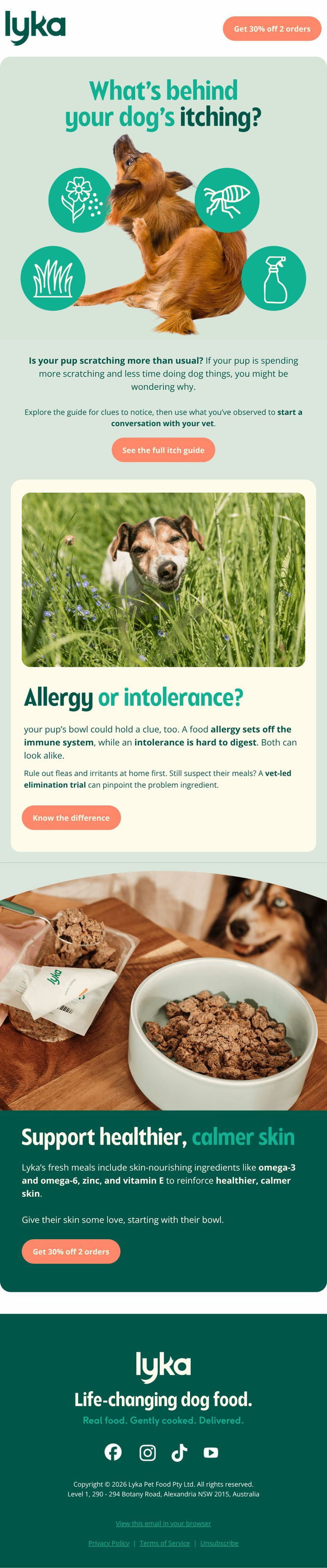
The “is this normal?” explainer

Effort: Medium

Why it works: The subject line is the question the owner was about to type into Google, so it gets opened before any offer is seen.

Run it with a small team

List the six questions your customer service inbox gets most often. That’s six months of emails.
Send one a month, on the same day, so it becomes a habit for you and for readers.
Build each answer on public guidance from the AVMA or ASPCA, and link to it.
End every email with “when to call your vet”. It protects the reader and protects you.
Mention your product once, near the end, only where it genuinely helps.

Why Medium: anything about symptoms should be read by a vet before it goes out. A freelance vet can review a quarter’s emails in one sitting.

The real emails

Click to read all of it, open full size, or download

Campaign 2 · Bring customers back

Myth or fact

Effort: Low

Why it works: It challenges something the reader believes, and the preview gives away the verdict, so people open to find out why. The format repeats forever without feeling repetitive.

Run it with a small team

Write down ten things your customers believe about your category that aren’t quite true.
Use one per email, always in the same order: the myth, the fact in one line, the reason, what to do instead, then the product.
Time the strongest one: dental myths in February, which the AVMA marks as National Pet Dental Health Month.

The real emails

Click to read all of it, open full size, or download

Theme 2 of 6

Answer the doubt

Most lost first orders come down to one unanswered question, like “will my cat use it?” or “why is it a subscription?”. Answer it plainly and you often win the order without a bigger discount.

Pet owners switch products slowly, because the pet pays for a bad choice. These two campaigns make trying you feel safe.

Campaign 3 · Win a first order

Switch stories

Effort: Low

Why it works: It talks directly to people still buying the product you replace, and makes switching sound like something lots of owners like them have already done. Catalyst’s preview does the math: one pound does the work of four pounds of clay.

Run it with a small team

Ask five recent customers what they used before and what made them switch. Their words become the email.
Lead with the old product’s most annoying problem (dust, smell, a dog who won’t eat it), then the before and after.
If switching itself is the worry, as with food, add a simple transition plan and say what’s normal in the first week.

The real emails

Click to read all of it, open full size, or download

Campaign 4 · Win a first order

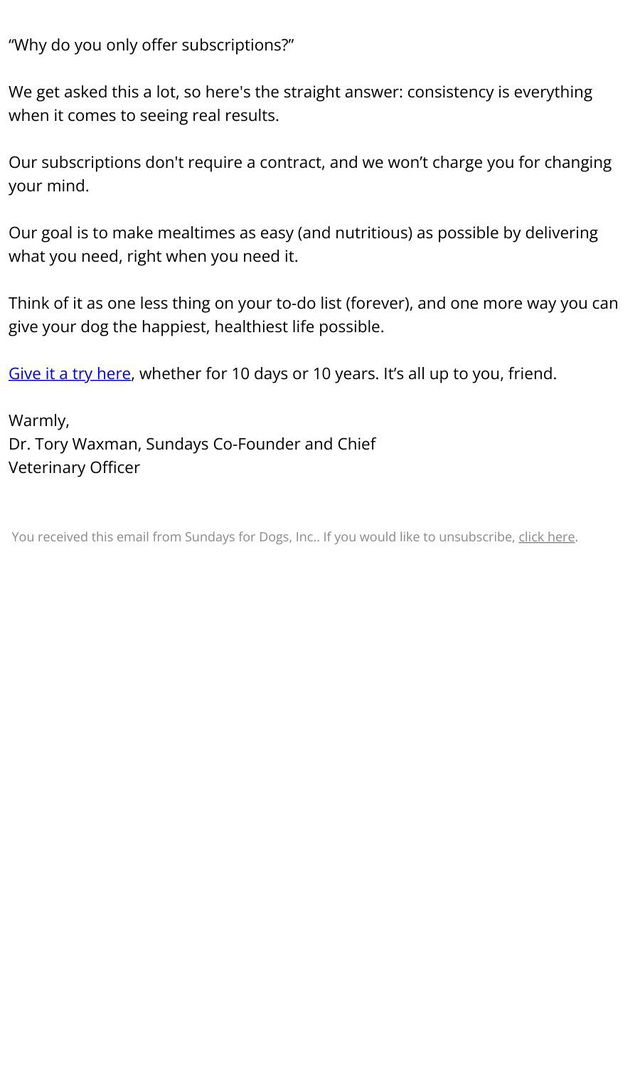
The honest FAQ

Effort: Low

Why it works: Saying the objection out loud reads as honest. Plain text signed by a real person reads like a note from someone at the company.

Run it with a small team

Pick the question that stops people at checkout: price, subscription, sizing, or “what if my pet won’t eat it?”
Have the founder answer it in under 200 words, in plain text, signed with their name.
Finish with what happens if it doesn’t work out: your guarantee, return policy, or how to pause.

The real emails

Click to read all of it, open full size, or download

Theme 3 of 6

Ride the pet calendar

On the nights pets dread, pet brands lead with calm. Of the 12 fireworks emails from pet brands in Mailboard’s library over the past year, 9 put calm or safety in the subject line. Only 3 led with a discount.

The pet calendar gives you reasons to email that have nothing to do with your own sales. Show up a few days early with something useful.

Campaign 5 · Bring customers back

The night-before planner

Effort: Low

Why it works: Owners already know the night is coming and feel anxious about it. A plan they can follow is useful enough to save, and the products sit inside the plan.

Run it with a small team

Pick your nights: 4th of July, Halloween, New Year’s Eve, plus thunderstorm season if you sell calming products.
Structure it in three parts: before, during and after. Put your product only where it fits.
Send it three to five days ahead, then a short reminder the day before.
Group the relevant products into a “kit” at normal price. A small free gift works better than a discount here.

The real emails

Click to read all of it, open full size, or download

Campaign 6 · Bring customers back

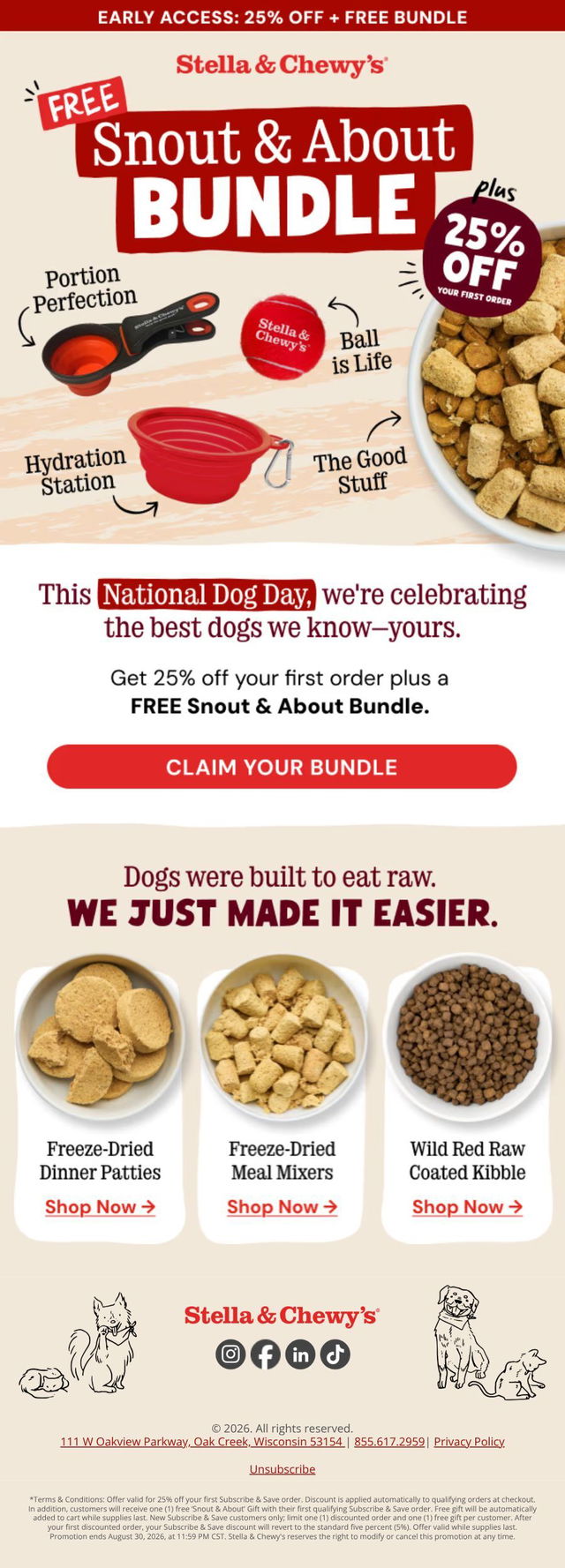
A letter from the pet

Effort: Low

Why it works: The pet’s voice is funny, and the “list of requests” lets you link products while the reader is still smiling.

Run it with a small team

Choose the days that match your animal: National Puppy Day (23 March), International Cat Day (8 August), National Dog Day (26 August), National Cat Day (29 October). Small-animal brands have them too, like Adopt a Rescued Guinea Pig Month in March.
Write it as the reader’s pet, in the first person. Three to five “requests”, each one a product.
If you run an offer, give your list early access a few days before the day itself.

The real emails

Click to read all of it, open full size, or download

Theme 4 of 6

Celebrate the pet

Most pet brands know the owner’s name and never learn the pet’s. One email asking for the pet’s name, birthday and age makes every later email about their pet.

An email about someone’s own pet is the one they read to the end, and sometimes show to the rest of the family.

Campaign 7 · Learn about the pet

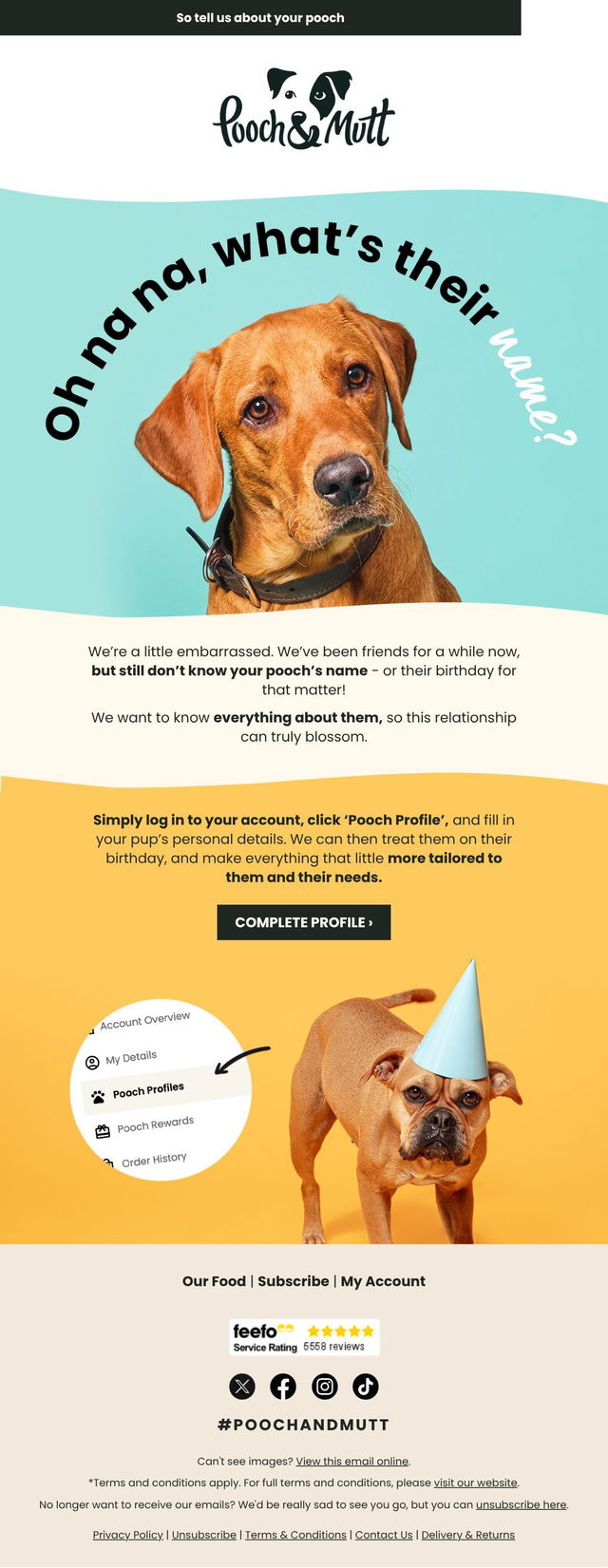
Tell us about your pet

Effort: Low

Why it works: It’s honest and a little funny (“we’re a little embarrassed”), and it promises something back for the information: a birthday treat.

Run it with a small team

Build a short form in your email platform: pet’s name, species, birthday or adoption day, and age (puppy, adult or senior). In Klaviyo these save straight to the profile.
Send it to your whole list once, then again two weeks later to anyone who hasn’t filled it in.
Say exactly what they’ll get back, like a birthday treat or advice for their pet’s age.

It’s one form and one email, and it powers campaign 8.

The real email

Click to read all of it, open full size, or download

Campaign 8 · Bring customers back

The life-stage edit

Effort: Medium

Why it works: The email reads as advice for this owner’s pet, so the products feel like recommendations. Once you know birthdays, it can be personal too.

Run it with a small team

Segment by life stage, using the ages from campaign 7 or past purchases of puppy, adult or senior products.
Write one email per stage on what changes at that age, then show the three products that fit.

Send the senior edit in November, and the puppy or kitten edit around National Puppy Day in March.

Why Medium: you need age data first, and photos of each product range.

The real emails

Click to read all of it, open full size, or download

Theme 5 of 6

Prove it

Pet owners trust other pet owners more than they trust brands. The most persuasive line in a pet email is usually a customer’s.

Reviews on a product page do little for someone who never visits it. These two campaigns put that proof in the inbox.

Campaign 9 · Win a first order

Proof at scale

Effort: Low

Why it works: A large, specific number makes the reader feel late, and the owners’ own words answer the doubts the brand can’t credibly answer itself.

Run it with a small team

Use a real number you can stand behind: orders shipped, pets fed, five-star reviews. Never round up.
Group three to five reviews by the problem they solved: picky eater, itchy skin, the harness they slipped out of.
Include the pet’s name and a customer photo wherever you have permission.

The real emails

Click to read all of it, open full size, or download

Campaign 10 · Bring customers back

Ask, then share the replies

Effort: Low

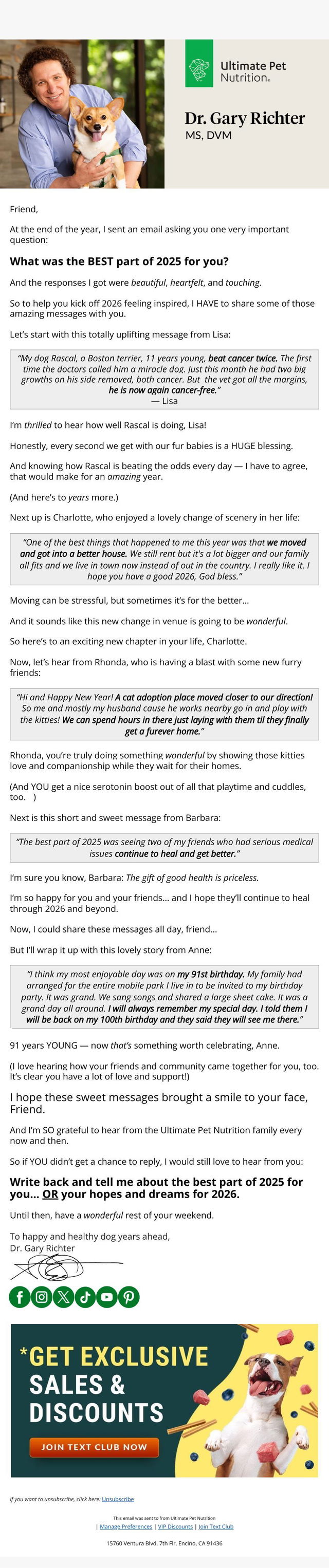
Why it works: Vet Dr. Gary Richter asked readers for the best part of their year, then shared five answers back, including an 11-year-old Boston terrier who beat cancer twice. Readers see people like them, and replies tell inbox providers people want your emails.

Run it with a small team

Email one: a single question in plain text, like “What’s the funniest thing your pet did this year?”, with “just hit reply”.

Email two, a week later: the four to six best answers, first names only, with the sender’s permission.
Keep the product out of the first email entirely. In the second, one quiet link at the end is enough.

The real emails

Click to read all of it, open full size, or download

Theme 6 of 6

Sell without shouting

A pet brand that discounts every month teaches customers to wait for the code. A free gift, a good reason or a better question can still sell the same week at full price.

You still need sales emails. These two sell clearly without training your list to wait for the next code.

Campaign 11 · Win a first order

The mystery gift

Effort: Low

Why it works: The surprise makes people curious, the pet gets something, and the price stays where it is.

Run it with a small team

Choose a low-cost item the pet can wear, play with or eat: a bandana, a toy, a sample bag of treats.
Show the possible styles, but not which one they’ll get.
Send three emails in a week: the announcement, a reminder, and a last call.

Order the gifts early so you don’t run out halfway.

The real emails

Click to read all of it, open full size, or download

Campaign 12 · Win a first order

“What do they really need?”

Effort: Low

Why it works: In sale week every other email is a percentage. Shopping by the pet’s needs is easier, and it reads as advice.

Run it with a small team

Pick the four needs your range covers, such as chew, sleep, walk and calm.
Show one product for each need, with a line on how to tell if their pet needs it.
Use it as the first email of a sale, before the reminders and countdowns.

The real email

Click to read all of it, open full size, or download

Plan the year

A US pet email calendar for 2027

The 12 campaigns fill a year on their own. Campaign numbers refer to the sections above.

WhenMomentCampaign to send
Early JanuaryNew year7. Tell us about your pet, then 10. share the replies you asked for in December
FebruaryNational Pet Dental Health Month2. Myth or fact, on teeth
MarchNational Puppy Day (23 March); Adopt a Rescued Guinea Pig Month8. The life-stage edit for puppies, or 6. A letter from the pet
30 AprilAdopt a Shelter Pet Day10. Ask readers how they found their pet
June to AugustSummer heat1. The “is this normal?” explainer, on heat
30 June to 3 July4th of July (a Sunday in 2027)5. The night-before planner
8 and 26 AugustInternational Cat Day; National Dog Day (a Thursday)6. A letter from the pet
Late OctoberNational Cat Day (29 October); Halloween5. The night-before planner
NovemberNational Senior Pet Month; Thanksgiving (25 November)8. The senior edit; 1. an explainer on foods to keep off the plate
26 to 29 NovemberBlack Friday and Cyber Monday12. “What do they really need?” first, then 11. The mystery gift
Mid DecemberEnd of year10. Ask the question for January’s email
27 to 30 DecemberNew Year’s Eve5. The night-before planner

Campaigns 3, 4 and 9 work in any month. Send them to people on your list who haven’t bought yet.

Questions pet brand owners ask us

What emails should a pet brand send besides discounts?

Six kinds work well: emails that teach something, answer a doubt, follow the pet calendar, celebrate the customer’s pet, show proof from other owners, and sell with a gift or a reason instead of a code. Each theme above has real examples.

How often should a small pet brand email its list?

Our starting point for most small pet brands is one useful email a week, plus extra sends around Black Friday and the pet holidays that suit your animal. Go by your own unsubscribe and spam-complaint rates. If they climb, send less or make the emails more useful.

Do I need a vet to write pet emails?

Not for most of them. You do need one for anything about symptoms, health conditions or what a product does for the body. Build those emails on public guidance from the AVMA or ASPCA, link to it, and always say when to call a vet.

What’s a good pet email for Black Friday?

Open the sale by sorting products by what the pet needs (campaign 12), then add a free gift with purchase (campaign 11) instead of a deeper discount. If you sell subscriptions, write separate emails for current subscribers and everyone else, as we did for BunnieBox.

Do these ideas work for cat and small-animal brands?

Yes. Catalyst, Weruva and Travel Cat are cat brands, and two of the three brands we show are for rabbits and guinea pigs. Every campaign works for any pet. Only the calendar dates change.

Can AskTimmy run these for us?

Yes. We plan, write, design and build the campaigns in your Klaviyo, and you approve each one. Your first month is free, so you can judge the work before you pay for it.

Rather have it done for you?

Why pet brands work with AskTimmy.

Everything in this playbook you can run yourself. If you’d rather hand it over, this is what we bring, and how to try us without risk.

01

We’ve already done pet.

We write Coco Therapy’s emails every month, from pet health guides to National Dog Day, and ran Black Friday 2026 for BunnieBox and GPigBox, two small-animal subscription boxes.

02

We do the work, inside your Klaviyo.

We plan the calendar, write the emails, design them in Klaviyo’s own editor so your team can change them, then build and send them. You approve each one.

03

A Klaviyo Master Gold Partner.

Started by Timmy in 2009, now a team of 12 running email and SMS for DTC brands.

04

Your first month is free.

We run your campaigns for a month before you pay anything. You decide on the results.

Pet campaigns we’ve built

Coco TherapyCelebrate the pet

Happy International Cat Day 🐱🥥

Coco Therapy email by AskTimmy for International Cat Day, introducing the team's three cats

Sent for International Cat Day: the team’s three cats introduced one by one, then an invite to share yours. Product waits until the very end.

Scroll the window to read it allOpen full size ↗
Coco TherapySeasonal moment

Happy Halloween! 🎃🐾🥥

Coco Therapy Halloween email by AskTimmy with the team's dogs in costume

Sent on Halloween: the team’s dogs in costume and a call for readers’ costume photos, with treats saved for the end.

Scroll the window to read it allOpen full size ↗
Coco TherapyTeach something

Nom Nom Nom 🍪🥥🐶

Coco Therapy email by AskTimmy with homemade dog treat recipes

Homemade dog treat recipes for November baking, with CocoTherapy’s treats as the shortcut for busy owners.

Scroll the window to read it allOpen full size ↗
[Client video testimonial, 60–90 seconds]

“Email became our highest-performing channel within months, thanks to AskTimmy.”

David, Founder, Coldest

Client results from our case studies

Your first month is free.

Book a 30-minute call and send us your store link beforehand. We’ll bring the three campaigns from this playbook we’d send first on your list, with a draft subject line for each. Want us to run them? The first month is on us.

Book your 30-minute call →The three campaigns are yours to keep, whether or not we work together.

How we chose these

We searched the Pets section of Mailboard’s email library for campaigns sent between 26 November 2025 and 26 November 2026, by theme: education, myths, switching, fireworks, pet holidays, birthdays, reviews and gifts. We kept campaigns a small team could repeat, and chose cat and small-animal examples where they were as strong as the dog ones. Effort ratings and the theme summaries are our own judgment.

The fireworks count covers the 12 pet-brand emails that matched “fireworks” in that library and period. It’s a sample of what Mailboard collects. Brand names and emails belong to their owners; including them isn’t an endorsement.